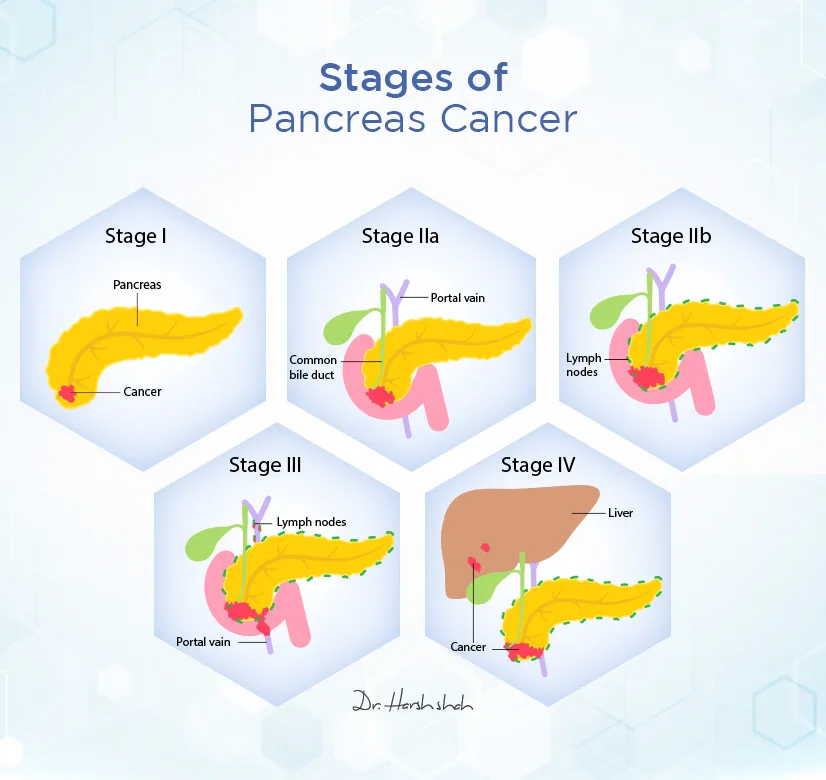
Staging is done mainly with a contrast CT scan of the abdomen (CECT). A CT angiogram may be added to check whether blood vessels near the pancreas are involved, and a PET-CT scan is used in selected cases to look for disease elsewhere in the body. The blood marker CA 19-9 can also help, particularly in a person who is not jaundiced. Stages run from 0 to 4.
Stage 0 means cancer is confined to the top layer of cells lining the pancreatic duct. Stage 1 means it is limited to the pancreas, and stage 2 means it may have grown into nearby tissues. Stage 3 means more extensive local spread, for example to nearby lymph nodes or major blood vessels, and stage 4 means it has spread to distant organs. The surgeon explains the exact stage after reviewing the scans.
Treatment depends on the stage and on the person's overall health. Surgery is most useful when the cancer is localised and has not spread to other organs. Chemotherapy may be given before or after surgery, or as the main treatment, and radiation therapy is sometimes used before or after surgery or when a person is not fit for an operation. Targeted therapy and immunotherapy are options in advanced disease.
Early pancreatic cancer often causes no symptoms. As it grows it can cause pain in the upper abdomen or back, yellowing of the skin and eyes (jaundice), weight loss, tiredness, changes in appetite, nausea and vomiting. These symptoms have many other causes, but if they persist it is sensible to see a doctor and get them checked.
The risk factors for pancreatic cancer include:
⦿ Age: Pancreatic cancer is most common in people over the age of 65.
⦿ Smoking: Smoking is the leading risk factor for pancreatic cancer.
⦿ Obesity: People who are overweight or obese have an increased risk of pancreatic cancer.
⦿ Diabetes: People with diabetes have an increased risk of pancreatic cancer.
⦿ Family history: People with a family history of pancreatic cancer have an increased risk of developing the disease.
Pancreas cancer is staged with the help of CECT Abdomen. The surgeon may ask for a CT Angiography to look for vascular involvement. In certain clinical scenarios, the surgeon may choose for PET-CT Scan which will scan entire body for tumour evidence. Blood CA 19-9 levels is a helpful marker in a non-jaundiced patient.
Effective for localized cancer, not spread to other organs.
Uses drugs to kill cancer cells, used before or after surgery or as the primary treatment.
Kills cancer cells with high-energy rays, used sometimes before or after surgery or as the main treatment when the patient is unfit for an operation.
Targets specific molecules in cancer cell growth, often combined with chemotherapy or radiation therapy. Used in advanced disease.
For advanced pancreatic cancer.
Where to get help
Dr Harsh Shah, MS, MCh (Surgical Gastroenterology), DrNB (Surgical Gastroenterology), does pancreas cancer surgery at Dr. Jivraj Mehta Hospital, Vasna, Ahmedabad.
He operates here in Ahmedabad. You can read what this care involves on our page on surgery for pancreas cancer. Bring your reports. Second opinions are welcome.
Call +91 63555 64601
Ask on WhatsApp
Last updated: 12 September 2026
Swasth Parivar: every week, practical advice on recovery, diet and warning signs. No advertising. Stop any time.
Your number is used for these updates and for the clinic to reach you. It is never sold or passed on. To stop, reply STOP on WhatsApp.